An answering service puts a trained person on your calls, and an AI receptionist puts software on them.
The software answers at any hour and can take several calls at once, while the person brings judgement to calls that are sensitive or unusual. Most small businesses choose by call mix: AI for routine calls, people for the rest, or both.
The two options sound like they do the same job, and in one sense they do: both make sure a call isn't left ringing. The difference is who answers it, what they can do while the caller is still on the line, and how you pay for it.
Those are three separate questions, and they don't always point the same way.
An answering service can be the right answer for a clinic that fields worried callers, and an AI receptionist can be the right answer for a landscaper who mostly gets quote requests and booking questions.
Plenty of businesses end up with a mix, with software taking the routine calls and people taking the rest.
The aim of this guide is to help you work out which of those you are.
We compare the two types of service here. If you want named services and prices, our guide to the best AI phone answering services does that, and if the AI side is new to you, what an AI receptionist is and how it works is the place to start.
Comparing AI Receptionist and Answering
Here is the whole comparison. The first column is an AI receptionist, the second is a traditional answering service where people answer, and the third is a hybrid that combines the two.
The rest of this guide explains each row, so treat the table as the map.
AI receptionist | Answering service | Hybrid | |
Who answers | Software | Trained people, answering in your business name | AI first, with a person when needed |
What it does on a call | Answers from the information you give it, books, qualifies, takes messages and transfers | Follows your script, takes messages, and often books, screens and relays calls | AI handles the routine calls and a person takes the rest |
Hours | Always on | Many offer 24/7, though cover varies by plan | AI is always on, and live cover depends on the provider |
Calls at once | Several at once, depending on the plan | Limited by the staff on shift | The AI absorbs spikes and people take the overflow |
How it's billed | By the minute, the call, the caller, or a flat plan | By the minute or the call, often with an allowance | By the call, or a blend of both |
Cost as calls grow | Depends on the meter, steady on flat and per-caller plans and rising with call length on per-minute ones | Usually rises with the number or length of calls | Rises with how many calls reach a person |
When a call gets hard | Usually passes to your own team, or takes a message or callback | The service's agents handle it, or relay it to you | The service's live agents take over |
Sensitive or unusual calls | Weakest here | Strongest here | Strong where a person is brought in |
After the call | A transcript or summary, sometimes synced to your tools | A message or summary sent to you, which varies by provider | Both |
Weakest at | Emotional, high-stakes or very unusual calls | Cost and capacity at high volume | Two things to manage instead of one |
Every cell says "usually" or "depends" because services vary, so use the table to know what to ask, not as a promise about any one provider.
One more thing the table can't show: some AI receptionists also answer website chat and messaging, which makes them one kind of AI customer service agent.
If your customers reach you in more than one way, that matters more than the phone-only comparison.
How Each One Works: The Same Call, Answered Two Ways
The easiest way to see the difference is to follow one call through both. It's 6:40 on a Tuesday evening, you've closed for the day, and someone calls to ask if you can fit them in on Thursday and roughly what it will cost.
Moment | Answering service | AI receptionist |
Picks up | A trained agent answers in your business name | Software answers within a few seconds, also in your business name |
Understands the need | Follows your script and asks follow-up questions using their own judgement | Replies from the information you've given it, such as services, hours and common questions |
Books or takes details | May offer a slot, or takes a name, number and reason | In many set-ups checks your calendar, books a time and sends a confirmation |
If it gets hard | Escalates to you following your instructions | Transfers the call, takes a message or books a callback |
Afterwards | Details sent to you by email, text or an app | A transcript or summary, sometimes synced to your tools |
Where they divide is in what each one works from. An agent works from a script and their own judgement, so they can ask a sensible follow-up you never wrote down.
An AI works from the information you've supplied, so it's reliable on what it knows and needs a fallback for what it doesn't.
What you set up in the first place differs too:
- For an answering service: a script, the hours you want covered, and who to contact and when
- For an AI receptionist: your website or FAQs, your calendar, and the rules for when to transfer or take a message
A person brings warmth and flexibility. An AI brings speed and consistency, since the same call gets the same answer at 6:40pm or 3am.
Neither is better in the abstract, which is why the right choice depends on what your callers actually ask.
Takes Messages vs Completes Tasks: How True Is It Now?
You'll often read that answering services take messages while AI receptionists complete tasks. That was a fair description a few years ago, but it's only partly true today, and it can steer you wrong.
Many answering services now do much more than relay a message. Depending on the provider and plan, agents book appointments, screen and qualify leads, take payments and place calls on your behalf.
So "messages only" isn't a fair way to describe the category.
The difference that holds up is where the work happens. With a person, the task is done by an agent following your instructions, one call at a time.
With an AI, the task is done by software connected to your tools, so a booking can land in your calendar and a confirmation can go out while the caller is still on the line.
That last point has a catch. An AI receptionist that isn't connected to your calendar or CRM can only do what an answering service does: take a message. What it completes depends on what it's plugged into.
So don't compare labels, compare what each can do in your set-up. Three questions will tell you quickly:
- Can it book into my calendar during the call?
- Can it send the confirmation or update my records itself?
- What does it do when it can't help?
An AI receptionist like Joble's Phone Agent books into your live calendar and sends the caller a confirmation and invite, but the same question applies to any service you're considering.
How Each One Bills & What That Does to Your Month
Two services with the same headline price can produce very different bills, because they count different things. Before you compare prices, it helps to know which meter each one uses.
Meter | How it works | What drives your bill | Watch for |
Per minute | You get a block of minutes, then pay for extra | Call length and call volume | Long calls and busy months |
Per call | A set price for each call, whatever its length | The number of calls | Overage rates and spam or short calls |
Per caller | Each different caller counts once a month | The number of different people ringing | A rush of new callers |
Flat or blended plan | A monthly fee with an allowance, sometimes mixing minutes or calls | Whether you stay inside the allowance | What happens when you go over |
Answering services mostly bill per minute or per call, and AI receptionists use all four.
Hybrids often charge per call, with a higher rate for calls a person handles.
Here is how the meter changes a month. Say you get 100 calls averaging 3 minutes, which is 300 minutes. Now say your calls get longer, and each one averages 6 minutes:
- A per-minute bill doubles, because you're now using 600 minutes
- A per-call bill doesn't change, because you still have 100 calls
- A per-caller bill doesn't change, as long as the same people call
- A flat plan doesn't change until you pass its allowance
None of those is the cheapest in every case.
A service that charges per minute can be the cheapest if your calls are short, and a per-call or per-caller one can win if they're long.
The only way to know is to count your own minutes and calls from last month before you compare prices.
For a flat plan, Joble's Starter plan shows what an allowance looks like: it's €74 a month billed annually and includes 500 AI minutes, as shown on the pricing page.
For current prices on other named services, our guide to AI phone answering services sets them out.
After Hours and Busy Spikes: Who Is Still Answering?
Most calls you miss aren't missed because nobody cares. They arrive when no one can pick up: late in the evening, over a weekend, or all at once after a promotion goes out.
These are the two situations where the two types of service behave most differently.
1. Overnight, weekends and holidays: An AI receptionist is always on, so cover doesn't depend on a rota.
Many answering services also offer 24/7 cover, but it varies by plan, and some providers charge more for nights, weekends or holidays.
Ask exactly which hours are included before you assume.
2. A sudden spike: Say an email goes out at 9am and 30 people ring within the hour. An answering service is limited by the agents on shift, so extra callers may wait, be sent to voicemail or be passed to an overflow team.
An AI receptionist can take several calls at once, though how many depends on the plan, since some limit you to one at a time.
3. A quiet stretch: The opposite problem is less obvious. A service with a minimum or an allowance still bills when nobody calls, so a business with very uneven call volume should look at how each meter treats quiet months.
Three questions are worth asking any provider:
- Which hours are included, and does anything cost extra at night or on weekends?
- How many calls can it take at the same time on my plan?
- What happens to the caller who arrives when it's full?
Where People Still Win
If these describe most of your calls, an answering service, or at least a person on the line, is the better fit.
Here is where people still do better:
- Emotional calls: someone who's upset, frightened or grieving needs to feel heard, and tone matters as much as the answer
- Unusual requests: a question nobody wrote down is where an agent's judgement beats a script or a knowledge base
- High-value relationships: a long-standing client or a large enquiry can deserve a human voice from the first ring
- Calls where exact wording matters: if what's said on the call has consequences, you want a person who can weigh each sentence
- Hard audio: a bad line, heavy background noise or a strong accent can trip up software more than a person
None of that means an AI receptionist is out of the running. A good one is built to hand these calls over, not to attempt them, by transferring to your team, taking a message or booking a callback.
The question to ask is how many of your calls are routine, because those are where an AI is strongest, and how many fall into the list above.
The people-versus-software split also isn't all-or-nothing. Many businesses let software take the routine calls and keep a person for the rest, which is the hybrid set-up we look at next.
Hybrid Answering Service: Three Ways to Combine an AI Receptionist and Live Agents
You don't have to choose one side outright. A hybrid answering service uses software and people together, and there are three common ways to set it up.
They differ in how much changes for your business and who the person on the line is.
1. AI first, with live agents behind it: The AI answers every call and passes it to the provider's own live agents when a call needs a person.
This suits businesses that want a human backstop without staffing one, and the person who takes over knows your script but not your customers.
2. AI after hours and for overflow, your team in business hours: Your staff answer during the day, and the AI covers evenings, weekends, lunch breaks and busy spikes.
This is the smallest change, since nothing alters while you're open. Some AI receptionists, such as Joble's Phone Agent, offer it as a setting where your team answers first, and the AI catches the calls they miss.
3. AI for routine calls, a live service for sensitive ones: Booking questions and simple enquiries go to the AI, and calls that need judgement go to people.
This gives you the best of both, but it needs clear rules for which call goes where, and someone to maintain them.
Each has a cost to watch. Option 1 is billed per call, usually at a higher rate for the calls a person handles. Option 2 adds an AI service to your existing set-up, and option 3 means paying two providers.
Which Fits Your Calls: AI Receptionist, Answering Service or Hybrid?
The right answer depends on the calls you actually get, not on which type sounds better. Here is a starting point for the most common situations.
Treat each row as where to begin, not a rule.
If your calls are... | Start with | Why |
Mostly routine, such as hours, prices and bookings | An AI receptionist | These are the calls it handles most reliably, at any hour |
A mix of routine and sensitive | A hybrid answering service | The AI takes the routine calls and live agents take the rest |
Nearly all sensitive or high-stakes | An answering service with live agents | Judgement and tone matter on almost every call |
Mostly after hours or during busy spikes | An AI receptionist, or the hybrid where your team answers by day | It covers the hours and surges your team can't |
Spread across phone, chat and messages | An AI receptionist that covers those channels too | You get one place to see every conversation |
Very few, or very uneven month to month | Either, so check the billing meter first | A flat or per-caller plan can suit a quiet month better than per-minute billing |
If you're unsure which row you're in, here's a quick test. Take the last 20 calls or voicemails, and sort them into routine (answerable from a page on your website) and sensitive (needing a person's judgement).
If most are routine, lean towards AI, and if most are sensitive, lean towards live agents. If it's close to even, the hybrid is the sensible place to start.
Switching From an Answering Service to an AI Receptionist: A Two-Week Test
You don't have to swap one for the other overnight. A short parallel run lets you see how an AI receptionist handles your real calls while your current cover stays in place.
- Week 1, after-hours calls only: Forward just the calls that come in when you're closed, and leave everything else as it is. Those are the calls most likely to go unanswered anyway, so the downside is small.
- Check four things: Does it answer correctly from your information? Do bookings land in your calendar? Does the handover to a person work, and does that person know what the call was about? Do the transcript and details reach you afterwards?
- Week 2, add overflow: Send the calls your team or your current service can't take, such as lunch hours and busy spikes, and watch how it copes.
- Then decide: Keep the AI for routine calls, keep people for the rest, or choose the hybrid. Only cancel your current service after you've seen two weeks of results.
Two practical points. Keep your existing number and use call forwarding, so nothing changes for customers, and check your current provider's cancellation notice before you start, since some are month-to-month and others aren't.
It's also worth deciding whether your greeting should say it's an automated assistant, and checking the rules that apply where you operate.
Where Joble Fits Between an AI Receptionist and an Answering Service
Joble sits on the AI side of this comparison, with one foot in the hybrid camp.
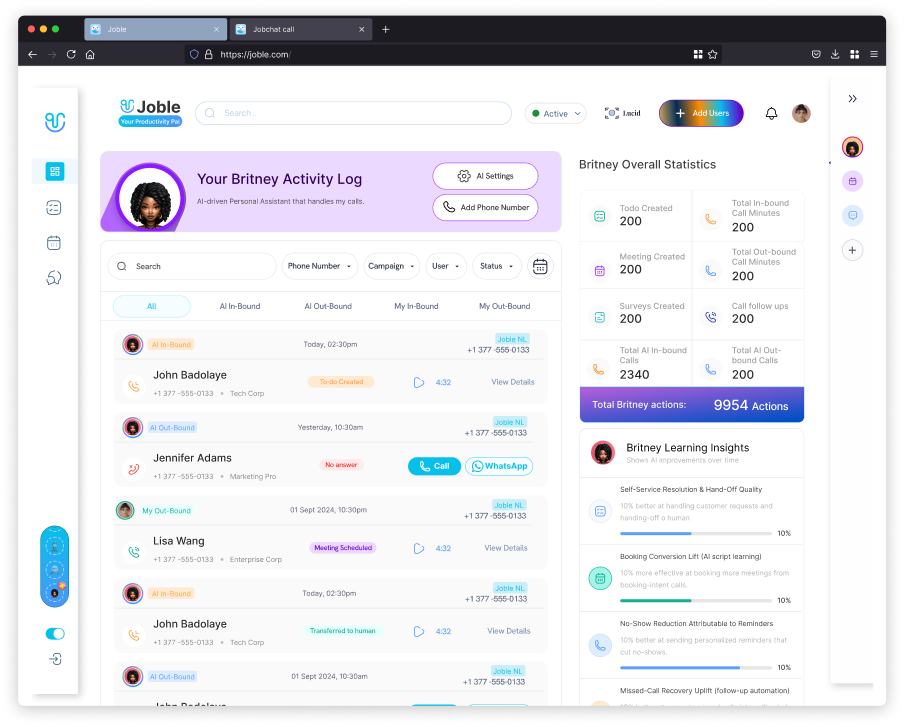
It's an AI customer-engagement platform for businesses of 5 to 50 people: its Phone Agent works as an AI receptionist on calls, and the same platform covers website chat, WhatsApp, email and SMS.
On a call, the Phone Agent does the things this guide has been describing:
- Answers in about two seconds, in 13 languages with automatic detection
- Books into your live calendar and sends the caller a confirmation and invite
- Transfers to your own team with the conversation attached, or takes a message or books a callback
- Offers three modes, AI first, Human first and AI only, so your team can answer first and let the agent catch the calls they miss
That last mode is the closest Joble gets to the hybrid set-ups described earlier, with the difference that the person who takes over is on your team, not the provider's.
It isn't an answering service. Joble has no outsourced live agents, so if you want trained people at the vendor to answer for you, a hybrid or live answering service is the right choice.
If the AI side fits your calls, Joble starts from €74 a month billed annually, with all five agents on every plan. You can see the plans on the pricing page, or read what Joble is for the full picture.
Frequently Asked Questions
Is an AI receptionist cheaper than an answering service?
It can be, but it depends on how each bills and how many calls you get. Count your own minutes and calls first, and for current prices on named services, see our guide to AI phone answering services.
Can an AI receptionist replace an answering service?
For routine calls, usually yes. For sensitive or high-stakes calls, many businesses keep people on the line, or use both.
Will callers know they're talking to an AI?
That depends on how it's set up. Many businesses say so in the greeting, and it's worth checking the rules that apply where you operate.
Can I use an AI receptionist and an answering service together?
Yes. Common set-ups are AI first with live agents behind it, AI for after hours and overflow, or AI for routine calls and a live service for sensitive ones.
Does an answering service book appointments?
Many do, depending on the provider and plan. Ask whether it books into your calendar during the call or only takes a message.
Can I keep my existing phone number?
Usually. Most services let you forward your current number, and some also offer number porting.
0 Comments
Be the first to leave a comment.
Leave a comment